



The area
Egtved is located right in the middle of Vejle Ådal, which beautifully presents you with the remains of the Ice Age. The area is also known as the Tunnel Valley, and it’s almost as if you’re not in Denmark, but in a far more northern clime. At Tørskind gravel pit you have a great opportunity to hike or cycle on the many beautiful nature trails, through Hærvejen and to Bindeballe grocery store. Along the way there are information boards where you can read and hear about the Ice Age and how the landscape in Vejle Ådal was formed more than 20,000 years ago.
Shopping
In addition, Egtved is a small town with lots of life. There are both shopping opportunities and several shops such as sports and clothing stores. There’s a hardware store, jewelry store, and if you’re unlucky, there’s a doctor, dentist, optician and chiropractor in town. If you’re up for a short walk, we’ve created a small footpath from the campsite so you can wander into Aftensang, the heart of Egtved, without walking in traffic.
Both Vejle and Kolding, which are about 20 km. drive from Egtved, also offer good outdoor and indoor shopping opportunities, as well as a rich café life.
If you have your teenagers with you, or if you’re up for a shopping trip yourself, there’s Bryggen in Vejle and Kolding Storcenter you can take a trip to. Both places are located at a distance of about 20 km.
Family attractions
Legoland Billund
The word LEGO is a combination of “Play” and “Good” and means “I put things together”. Genius!
Legoland is one of Denmark’s largest and most important brands. Parken er blevet udvidet flere gange og er udover en stor forlystelsespark, også et stort trækplaster for folk i alle aldre, der nyder at gå rundt blandt de tusindvis af legoskulpturer, der er vokset op gennem årene.

Leo’s playland, Kolding
If the kids need to burn off some energy or the Danish summer is showing its dull side, there are plenty of opportunities to climb, tumble and jump.

Lalandia Aquadome Billund
We’re talking about Scandinavia’s largest water park with lots of water slides, waves and hot tubs.

Lego House Billund
Legohouse has 25 million bricks for children and adults to build with. You can build digitally and physically, you can program robots, so as a visitor you have a great opportunity to unfold your creativity. You should book an appointment before your visit.

Økolariet Vejle
Økolariet is a knowledge and experience center where you can learn about our planet, both above and below ground. You can learn about pollution, the forest, the sea and climate change. An exciting place for everyone, and admission is free!

Refsgård Fishing Lake
Refsgård angling lakes consist of three lakes of different sizes. There is a special children’s lake so that everyone can have a good fishing experience. The lakes are open from sunrise to sunset.
If you want, you can bring your packed lunch (possibly from Egtved Camping’s shop) and children can play in the area if their patience is not as great as their parents’

Wow Park, Billund
You’ll need to get your hands on the rye bread machine because it’s your own strength you’ll need. There are suspension bridges, tree houses, giant slings and giant nets in the trees. And WoWpark Billund has the tallest free-fall slide tower in Scandinavia!

Givskud Zoo
Givskud Zoo is a great place to visit because you can take your own car into the park and drive around among the animals. You can even drive into the lion cage! You can bring your dog (on a leash) and if you come by shuttle bus, you can use the safari buses in the park.

Sights to see
The world of the Egtved Girl
The burial mound of the Egtved Girl was excavated in 1921 by curator Thomsen from Vejle Museum. It became one of the most spectacular finds in Danish Bronze Age archaeology. The Egtved Girl, who is approximately 3500 years old, was buried in a hollowed-out, debarked oak trunk, one half of which served as a coffin and the other as a lid. This type of burial was typical for high-ranking people in the Bronze Age.
What was remarkable about the find was not only the oak trunk coffin, but also the extraordinarily well-preserved textiles and personal items that accompanied the girl into the grave. She wore a short woolen sweater and a belt with a large bronze disk, as well as a knee-length string skirt – an iconic Bronze Age costume that has since become known around the world. At her feet were the remains of a child, and the coffin also contained birch tar remedies that may have had medicinal or ritual purposes.
Analysis of the Egtved girl’s hair and teeth has revealed fascinating details about her life. Strontium isotope analysis shows that she was not from the local area around Egtved, but most likely came from the Black Forest area in what is now Germany. She traveled considerable distances in the last years of her life, suggesting that she may have been part of a network of political marriages or trade connections between Bronze Age communities.
Today, you can experience the story of the Egtved Girl in several ways. There is a small museum near the burial mound where visitors can learn more about her life, the Bronze Age and the archaeological finds. The burial mound itself can still be visited at its original location in the South Jutland landscape. There is also a reconstructed Bronze Age village where you can get an insight into what life was like 3500 years ago.
The Egtved Girl has become a symbol of the Bronze Age in Denmark and of the connections that existed between different parts of Europe already in prehistoric times. Her story continues to fascinate researchers and visitors to this day.

The Hærvejen
Hærvejen – Denmark’s historical backbone through Jutland
Hærvejen is one of Denmark’s most iconic and historically significant routes. It stretches through the whole of Jutland and has for millennia served as a natural thoroughfare for people, animals, goods and culture. Today, Hærvejen is best known as a popular hiking and cycling route, but its history goes way back – before the Kingdom of Denmark even existed. As early as the Stone Age, people used the natural ridges to move dry-shod through the landscape, and over time these paths developed into a fixed route that became an important link between north and south in the Bronze Age.
In the Iron Age and Viking Age, the importance of the Army Road grew. It was used for trade, travel, military movements and as a connecting route between different centers of power. Many of Denmark’s most famous burial mounds, sacred sites and rune stones lie along the route, indicating its central role in ancient society. In the Middle Ages, the Hærvejen became one of Northern Europe’s most important trade and pilgrimage routes. Thousands of oxen were driven south to markets in Schleswig and Hamburg, and pilgrims traveled the route to major European shrines like Santiago de Compostela. That’s why it was known for centuries as the “Ox Road”, in German “Ochsenweg”, and it was crucial to Jutland’s economy.
Today, Hærvejen is a living piece of cultural heritage. It is carefully signposted, divided into stages and flanked by scenic areas, small towns, historical sights and cozy accommodations. One of the places close to Hærvejen is Egtved Camping. The location makes the campsite an ideal starting point for both short and longer excursions on the route. From here you can easily explore nearby stretches of Hærvejen, whether you want to hike, cycle or simply visit some of the historic sites in the area. The area around Egtved offers landscapes shaped by the Ice Age, forests, fields and cultural heritage – and is known for the Egtved Girl, which is also part of the prehistoric culture that characterizes the entire region.
To travel on Hærvejen today is to follow in the footsteps of thousands of years of travelers. You feel the presence of history in the landscape, in the old fords and in the small paths that still follow the natural ridges through Jutland. Hærvejen is not just a route – it’s a journey through Denmark’s history, nature and soul.

The footsteps of the Egtved girl
The route is approximately 14 km and can be divided into smaller routes. The route is in the heart of Vejle Ådal, which in itself is a cornucopia of nature experiences. The terrain is constantly changing, so it’s the gift that keeps on giving when you choose this route.

The Seven Spring Lakes
In the old days, lakes were thought to be magical, that they appeared every 7 years. However, this is not true, as the simple explanation is that they appear when the groundwater is high. The landscape here alternates between white beaches, (sometimes without water) swamps and open areas. There is a lot of terrain and in general, this part of the Frederikshåb plantation is incredibly fascinating.

Trapholt Art Museum, Kolding
Trapholt is a national cultural lighthouse in Kolding and a member of UNESCO’s Creative Cities Network. It is a museum for modern art, crafts and design. Arne Jacobsen’s Kubeflex summer house is an experience for those interested in design and architecture. There is a shop with a large selection of art and a cafe with the most beautiful view of Kolding Fjord.

Egtved Museum, Egtved
The museum in Egtved is private and run by the museum association. There are exhibitions about the liberation of Denmark, Egtved town, the Egtved-Kolding railway, the Bronze Age and of course the Egtved girl.

The Kings of Jelling
Kongernes Jelling – Home of the Viking Kings is Denmark’s most important historical site, where the story of the Viking kings Gorm the Old and Harald Bluetooth takes place. It was here in Jelling that Denmark got its name and became a unified nation over 1000 years ago.
The monuments consist of two impressive burial mounds, each 70 meters in diameter and up to 11 meters high, two rune stones and a church. King Gorm the Old’s smaller rune stone honors Queen Thyra with the inscription “King Gorm made this memorial after his wife Thyra, the adornment of Denmark” – the oldest mention of the name “Denmark” within the country’s borders.
Harald Bluetooth’s large rune stone from around 965 is Denmark’s baptismal certificate. On the stone he proudly proclaims: “King Harald erected this memorial after Gorm, his father, and after Thyra, his mother, the Harald who conquered all Denmark and Norway and made the Danes Christians.” The stone bears Scandinavia’s oldest depiction of Christ and marks the transition from pagan Nordic culture to Christianity.
The entire monument area is surrounded by a reconstructed palisade – the largest building of the Viking Age – marking the royal residence of Harald Bluetooth. The Jelling Monuments were inscribed on the UNESCO World Heritage List in 1994 as the first Danish site as they represent the birth of the Danish nation.
The modern experience center Kongernes Jelling is located in the middle of the monument area and offers free access to interactive exhibitions that tell the history of the Vikings through modern sensory technology. From the museum’s roof terrace, visitors can see what Jelling looked like 1000 years ago through digital binoculars.
Interesting fact: Bluetooth technology, which we know from cell phones and computers, is named after Harald Bluetooth because of his ability to unite warring parties and connect different devices wirelessly.


Bindeballe grocery store
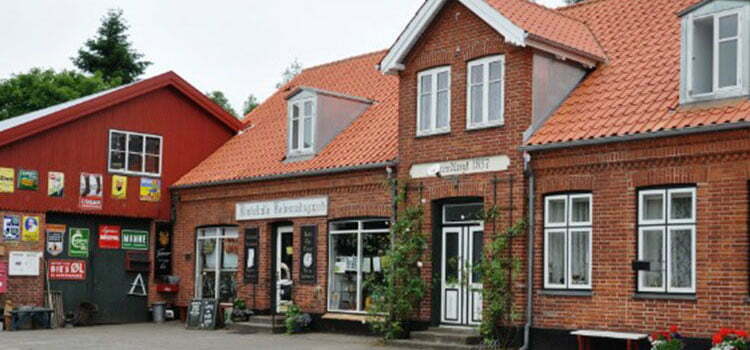
A cozy time warp to stop in. The grocery store is set up as a museum with items from a bygone era such as kitchenware, farming tools and toys, but also with “old” items you can buy. There is a cozy cafe where you can buy a cup of coffee, an “old” soda and a delicious piece of cake.
Randbøl Heath
Randbøl Hede takes you back to the Ice Age, to Sweden and to the North Sea all at once. You’ll need to wear good shoes and you’ll have a fantastic walk in sand, heather and lots of hills. Luckily, you’ll have the most beautiful scenery to look at in the meantime. Make sure you bring some drinks for the trip.

Tørskind gravel pit
In addition to Robert Jacobsen’s sculptures, the gravel pit also offers a great opportunity to explore nature and experience Ice Age remains on a grand scale. On some of the routes, you’ll be told stories about the Ice Age along the way in the form of buttons you can press, handles you can turn, etc. There are public toilets.
On Wednesdays, there’s a vintage car rally in the gravel pit, and depending on the weather, there can be up to 200 old cars for you to admire. There’s often also the opportunity to buy a sausage at the hot dog stand.
